
Shareholders ambush Zuck because being dead is bad for business
#459: A few hours ago, Meta's shareholders demanded Zuck tie exec pay to protecting kids before fines and regulation crush Meta's growth...


I have a confession. I have a complicated relationship with incentives.
I’ve always known they’re around, of course. Throughout my career, I’ve been given KPIs and targets to deliver.
But incentives are upstream of KPIs, and I didn’t need to understand them as a frontline newsroom executive.
That changed when I joined boards. My first was in financial services. I quickly learned the job was about satisfying shareholders.
My learning curve became steeper still with my own investors in my AI video start-up.
But my deepest understanding of incentives - and how they influence behaviours - has come from diving into the world’s largest tech companies - and Meta in particular.
It’s a horrible and addictive product used by 3.58 billion people every day.
It does terrible things to people and kills children but advertisers love it.
And is under attack everywhere in the world but it’s growing faster than ever.
How the f*ck does that happen?
People often ask me why’s Meta so bad? Why doesn’t it just stop hurting kids?
And my favourite: Meta has thousands of staff. Many of them must be good people so what forces good people to do bad things?
An amazing explanation comes from Meta director Kelly Stonelake, who wrestled with that for 15 years before quitting and becoming a whistleblower.
She explains in her Substack how the wool was pulled over her eyes working in the move fast and break things environment that blinded her to the harms.
The TL;DR is that when you really dive under the covers to see what makes Meta’s cogs spin, and CEO Mark Zuckerberg do what he does - it’s all about money.
I’ve said this before, so I risk sounding like a broken record, but it’s the money that creates the incentives. And it’s the incentives that cause the behaviour.
Which means that if 78,865 good people at Meta are getting richer because their core metrics are growing, then the feedback loop is telling them they’re doing a great job.
And that maybe the death of another 10-year-old can be overlooked if you are toiling in a competitive environment to build a future to have your own family.
But once you escape the One Hacker Way cult in Menlo Park, you see the world in another light.
The world is getting poorer. People are sad. Addiction is running rife. Anger is rising. Kids are dying. And the only people winning are bosses and shareholders.
But before you reach for the Prozac, there was a disturbance in the force a few hours ago.
A transition. A shift that has the power to make a fundamental difference if it builds momentum.
And that’s what I am sharing in this special free post today.
First, please join me in welcoming new subs over the past few days from AppliedXL founded by former Wall Street Journal and AP bigwigs to turn real-time data into editorial signals, antitrust and IP leaders Competition Dynamics, the Vice Dean at Princeton’s School of Public and International Affairs, the operator of the World Summit AI InspiredMinds in London, media development not-for-profit Internews as well as a professor from Harvard. Thanks for joining to my fast-growing community of leaders in media, tech and marketing which has now passed 38,000 subscribers and followers on Substack and LinkedIn across in 102 countries. 🙌
Now let’s get to it because I have a bee in my bonnet. TBH, I’ve been triggered…
The Big Story: Zuck it and see
A few hours ago, Meta held its annual shareholders meeting. It’s not an in-person thing. It’s a streamed audio feed. Impersonal. Boring. But today it had some drama.
Part way through, a group representing a huge chunk of Meta shareholders enacted an ambush.
As owners of the company, they demanded that Meta stops incentivising execs to hurt kids for profit, and instead to pay them more for improving child safety.
At first glance, that seems odd. Meta’s growing like a weed. Ad revenue is growing faster than its rivals.
👋 BTW, if you’re new, this chart is from Future Media Intelligence. FMI has hundreds of charts and decision-grade analyses of AI deals, regulatory shifts, business models and monetisation strategies built specifically for publishers. You can get access for $100-a-year. Use your corporate card. 🧾
So why are shareholders rebelling? And why would those with most to gain want to change the incentives that fuel a proven magic-money-machine?
Well, the answer is the avalanche of financial liability that Meta is now facing from courts, regulators and governments who have lost patience across the world.
It’s still down to money, but just a different way of looking at it.
Good cop
The shareholders have gotten their calculators out and assessed that social media has reached a critical transition; one where it makes more money by being good, than bad.
Meta passed $200 billion in revenue last year with 97.6% coming from advertising.
That advertising growth relied on a growing global audience, systematic data extraction, hyper-targeting, increased engagement and growing ad loads and prices.
Get access to all Future Media Intelligence charts with a $100-a-year paid sub.
Blend it in the Meta-mixer and you have 22% growth and another bumper year.
All good in the revenue and growth side then.
Only… that plan has cancer. And that’s what the shareholders were flagging this morning.
Cash crash
Because Meta’s great financial year disguises a fast-emerging crisis - and one that has the power to shift those incentives I started this post talking about.
The investors reckon the $200 billion in revenue and Meta’s $1.6 trillion valuation are critically threatened by the path it’s on.
From Bogota to Bern, Meta is being regulated and fined and controlled by governments, courts and consumers.
I’ll break that down in a moment. But first you need to know about a little reported court case in Delaware - because it was nuclear.
Meta’s calculus is that fines - even in the tens of billions - are just a cost of business. Who gives a sh*t. We got insurance, right?
Only, no.
In February, Delaware’s Superior Court ruled that Meta’s insurers - Hartford, Chubb and more than 20 others - have no duty to defend it in the thousands of child safety lawsuits piling up against it.
Duty to defend is the first line of cover. It’s who pays the legal bills. And defending thousands of cases is staggeringly expensive.
And why won’t they pay? Because the court agreed Meta’s conduct was “not accidental”.
Put another way, Meta knew exactly what it was doing. And you can’t insure a deliberate act.
The judge stopped short of the bigger question - whether the insurers must also cover the damages and penalties when they land. He left that fight for another day.
But here’s the kicker. The same “not accidental” logic that just stripped Meta of its defence cover is the logic that could deny it cover for the fines too.
So the safety net Meta assumed was under it is unravelling. The legal costs already land on the balance sheet - and the damages may follow like a bomb.
And who picks up the bill? Meta’s shareholders. How long’s that going to last?
The cold, hard truth is that for Meta’s shareholders it’s made more sense to turn a blind eye to the bad stuff and bank the spoils.
Meta’s stock surge
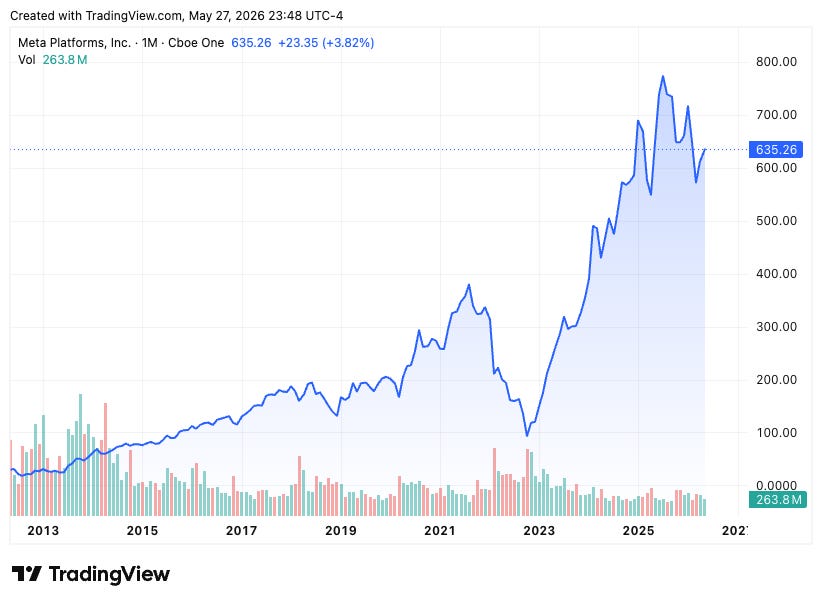
Investors in Meta’s IPO in May 2012 have seen their money grow 1,575% or 16.8 times since. Its market cap was $1.6 trillion this morning.
Investors have gotten very rich indeed, but calculus shifted with this morning’s rebellion.
It all kicked off at 10am Pacific time. At first, it was business as usual. Suck up directors re-elected. ✓ Ernst & Young auditing signed off. ✓
Yay! Almost time for the board lunch, only… then there was Agenda Item 10. It barely got noticed. But that was where the dynamite had been packed.
It was a request from shareholders holding $800 million of Meta’s stock demanding a report on the feasibility of linking child-safety performance to senior exec pay.
Not only was it a shift, the timing was also highly provocative, because of a financial filing Meta quietly made to America’s financial regulator the SEC a few weeks ago.
$900 million salary
Meta had just walked out of the Los Angeles Superior Court battered and bruised after being found liable of harming kids when the filing was made.
The note alerted the Securities and Exchange Commission that Meta intended to give a handful execs a $900 million pay rise each if they kept the company growing.
The bar was set high. They had to grow Meta another 5x to $9 trillion to qualify, which meant doubling down on the bad stuff.
Meta’s CFO was already warning that a slew of court cases and regulatory changes including Australia’s under-16s social ban were a material risk to its business.
Susan Li warned shareholders “scrutiny on youth-related issues” and trials “may ultimately result in a material loss”.
It was the first time Meta had ever issued such a warning.
Nowhere in the unprecedented pay award was any mention of protecting kids.
It was basically a sick loyalty test: How many of you are OK with letting kids die for $900 million?
Shareholders were expected to pick up the bill. And they were pissed.
And at the front of the queue were two heroines. One a rock and the other an insider.
The rock
The chief troublemaker was Dr Lisette Cooper - and she’s fascinating.
She emerged from a small liberal-arts college in Connecticut to study for a doctorate in geology at Harvard in the late 1980s.
Back then Wall Street was paying big money for quants. It was desperate for nerds who could see signals in statistics, and she was one of the best.
She bounced through a few firms before setting out on her own. Her firm became the top-ranked wealth manager in the US.
By the time she sold, the richest people in America trusted her with $6 billion.
She pioneered what’s now known as impact and sustainable investing - aka invest in good causes like environmental protection and social values.
Today, the mother-of-three is one of the most powerful impact investors in America.
She’s also massively connected.
She sits on the Business Executives for National Security group which briefs the US on national security.
BENS was established in 1982 when America feared a nuclear war. Mining magnate Stanley Weiss founded it to share wisdom with national security advisors.
He commented in an interview at the time the simple fact that “being dead is bad for business”. It’s now BENS’ unofficial slogan.
It’s briefed every US administration since Reagan, as well as the Pentagon, the Department of Homeland Security, and the National Security Council.
Cooper’s contribution has been to flag the risk posed by disinformation and privacy invasions on social media to national security.
And that has made her a dangerous adversary on a collision course with Meta.
She said: “Internal company documents released during recent lawsuits show that Meta executives knew harm was being done and did little or nothing to stop it.”
The whistleblower
Kelly Stonelake was a Meta devotee for 15 years. She rose to director, and led work on Zuck’s vision for the Metaverse before she saw the light.
Now she has emerged as one of its most credible internal critics, working to right the wrongs she did and saw.
At 10.30am Pacific time this morning, she spoke to the shareholders.
She’s meticulous, detail focused, and ambitious. She knows where the skeletons are, and the impacts. And this morning she brought the receipts and the evidence.
She told shareholders: “The proposal asks for a report assessing the feasibility of integrating child safety improvements into Meta’s senior executive compensation program.
“Meta’s Board calls this unnecessary, citing child protection as a company priority.
“But executive compensation is tied to the stock price, which largely reflects growth and revenue - without any child safety performance condition. And it’s not working.
“At least 15 countries are advancing social media restrictions for minors as Meta faces thousands of pending child safety lawsuits from attorneys general, school districts, and grieving families.”
FMI is tracking more than 50 countries that are considering or enacting social media restrictions based on Australia’s world first under-16s ban.
She continued: “Meta’s insurers are not obligated to defend claims like these because they’re based on Meta’s intentional business decisions, not accidents.
“These decisions to increase engagement and revenue often bolster the stock price but lack transparent accountability for the consequences of those choices - like physical and psychological harm to kids including sextortion, grooming, suicide, human trafficking, cyberbullying, and addictive endless scroll.”

My February exclusive with Nathan Witkin from NYU Stern’s Tech and Society Lab revealed how:
Instagram connected 1.4 million predators to underage kids in a single day
Meta platforms were used by sex traffickers to recruit children, and
Meta’s leadership knew but chose to ignore it to record record profits.
“Other industries recognise that when their core business creates safety risks, executive compensation must reflect proportional responsibility,” she continued.
“Former Oculus researchers testified that Meta’s legal team altered or omitted findings about children exposed to grooming or sexual misconduct.
“Executives must be incentivised to prevent child safety failures, not just manage Meta’s exposure to them.
“Meta’s Board said the company does this through products like Teen Accounts, but independent testing found that only eight of the 47 tested youth safety features worked as described.
“Executives must be measured against whether child safety systems actually work, not whether Meta can manage the optics.”
She then called out her former boss.
“To Meta’s majority shareholder and my former boss, Mark Zuckerberg:
“If you don’t want 50 states, dozens of countries, and thousands of lawsuits threatening business sustainability and dictating child safety requirements, explore a compensation structure that would incentivise your leaders to solve the problem first.”
The motion was supported by investor Michael Passoff. He said a pivot to people over profit would “align company commitments and practice”.
“Numerous large cap companies link safety performance directly to executive bonuses,” he said.
“Meta operates in a sector where the child safety risk is now producing nine-figure jury verdicts
“Making child safety financially significant to leadership isn’t just an ethical position - it’s long-term value protection.
“Concern about child safety is not going away.
“Meta is facing potentially billions of dollars in fines and regulatory penalties, and it has the data - harassment reports, user time, underage account removals - allowing child safety to be measured precisely enough to serve as a compensation metric.”
Change maker
The message was clear: It now makes more commercial sense for Meta to do the right thing, than the wrong thing.
And if that radical concept takes off, then doing the right thing becomes the incentive.
And if a new incentive exists, then real change will happen.
But it’s an uphill challenge. Investors have been raising child safety concerns with Meta since 2019.
Two years ago, 59 per cent of Meta's independent shareholders voted in favour of child safety proposals not dissimilar to today.
A coalition of 36 institutional investors representing $3.6 trillion in assets warned Meta child protection was one of its top concerns.
Zuck ignored them. And he can, because…
Poxy vote
When Facebook was just a wannabe, Zuck chanced across this guy called Peter Thiel. He was one of the PayPal Mafia, alongside Elon Musk and LinkedIn’s Reid Hoffman.
Thiel has an odd view of the world, believing Silicon Valley technology is the only path forward, and if it kills the species along the way, then so be it.
Thiel became Facebook’s first outside investor, throwing in $500,000 for a 10% stake at a $5 million valuation.
He then sat at Zuckerberg’s right hand for the next 17 years, guiding Meta’s growth and philosophy. Zuck was 20 years old at the time, and impressionable.
It led to Zuck’s twisted world view, which I have covered in this eight-part series.
Thiel was on the board when Facebook listed in 2012. Shortly before, it introduced a dual-class share regime, which gave Zuck 10 votes for every one shareholders had.
It gave Zuck total control the company. He can’t be fired. Independent shareholders can unanimously vote against him and still be overruled.
If he thinks the board is turning against him he can dump it and build a new one. He has complete control of Meta.
But he’s not above the law. And that’s what the rebelling shareholders are banking on...
Rough numbers
To make the point, they outlined the legal jeopardy across 11 pages of detailed, dollar-focused data. Stacked, and dated. It read a lot like this newsletter.
New Mexico
A jury penalised Meta $375 million in March for misleading users about platform safety while children were being targeted by predators. The state is now seeking $3.7 billion in penalties and a court-ordered platform redesign. It wants age verification, predator removal, restrictions on encrypted messaging for minors’ accounts.
Then
Los Angeles

Literally, a day later, another court awarded $4.2 million in damages to a young woman who became addicted to Instagram aged nine. The damages were nothing, but the precedent they set making it highly consequential. Meta’s people were not held liable, its tech was. It was the first time a jury found Meta’s addictive design was negligent.
Both are what’s known as bellwether cases, meaning they can be used by others as proof of harm by potentially millions of other victims to claim damages.
And each bellwether case sets a legal precedent that the next builds on, creating a liability snowball that gets bigger as it gets faster.
In California, 2,407+ active lawsuits are headed to court alleging that the platforms were addictively designed and caused mental-health harm to minors.
America’s Children’s Online Privacy Protection Act (COPPA) also has the power to issue $53,088 fines per violation, per day. Internal documents surfaced by whistleblowers prove Meta knows it has millions of under-age users.
And the proposed GUARD Act which passed the US Senate Judiciary Committee last month imposes fines up to $250,000 per violation for harmful AI interactions with minors.
In Europe, Meta is facing $12 billion in fines under the Digital Services Act. Europe has had enough of court cases and its new laws assume Meta and other tech “gatekeepers” are guilty.
The only question then are the fines. And they are enough to make shareholder shudder. How about rolling daily penalties of up to 5% of global turnover?
Europe is also demanding redesign including making minors’ accounts private by default and reducing push notifications for kids which gut Meta’s engagement.
And here’s a tell
Meta is already paying to make these go away.
The first bellwether case - picked to show both sides how a jury might react - was a lawsuit by a small Kentucky school district set for trial in Oakland next month.
Meta has just settled it with secret terms. YouTube, Snap and TikTok who were already dragged into it settled days before.
The money bought Meta silence. Zuck and unlikeable Instagram boss Adam Mosseri were lined up to testify. Now they won’t.
But it’s one case. There are 1,200 school districts queued up and the theoretical liability is ~US$400 billion.
The next bellwether - Tucson - is set for January. How much time and how much money is Meta willing to keep paying before it changes?
Because…
Meta’s under-reported vulnerability
Let’s be clear. Meta is not a social media company, it’s an ad company. It makes 97.6% of its income from ads.
Meta is utterly reliant on ads for its revenue. It stands on one leg. And far more so than all its tech peers. Without ads, it tumbles, so it’s dangerously exposed to disruption.
If brands, agency groups and mom and pop and/or small businesses listen to the victims, courts, regulators - and now investors - and pull their spend, Meta’s in crisis.
Meta’s strategy has been to increasingly build AI to create posts that engage readers, and then to use AI to create and sell and traffic the ads against them.
Using AI reduces the risk of a human moral backlash.
Meta’s also been stacking its earnings by flogging its audience with rising ad loads, and grinding advertisers with higher prices.
Meta’s most recent financial filings show how it is digging into its goodwill with advertisers by flooding Instagram, Facebook and WhatsApp with more and more ads, and charging advertisers more and more.
Addictive features multiplied by price hikes times double digit ad load growth and cheaper AI automation is the flywheel driving Meta’s 22% YOY growth.
That’s the same mechanism of harm that the LA jury ruled negligent and New Mexico ruled must be redesigned, and regulators globally are closing in on.
How long will it be before Meta’s one trick pony looks lame?
One way traffic
No decision has yet been made on the shareholders’ demand. That’s not how it works. Meta gets to go away and think about it, but Zuck can kill the proposal on his own.
But it has put Meta on notice. Shareholders are unhappy about the way he’s leading the company they own. They want a rewiring of the rewards to help kids.
The reasons to be being bad are starting to be outweighed by the incentive to be good. A few quick moves and Meta’s business model risks capsizing.
Fines are getting bigger and faster. Regulation is growing in impact and momentum. Courts are forcing changes to Meta’s product which throw sticks into its flywheel.
I’m sticking with my two-year-old prediction that Zuck will end up in jail.

How long will society tolerate this guy?
Right now he has cover. He has political allies, Silicon Valley powerbrokers propping him up, and advertisers only just cottoning on that they might be on the wrong side.
But the epiphany will land eventually.
And when the world turns on him, the man who made trillions grifting on 3.58 billion friends will find himself alone.
His countless enemies will strike. And he will learn what happens when the law moves fast and breaks things.
Great to see someone is as triggered as I am. I'm a media literacy educator (20+ years) trying to prevent teen/kid mental health and safety nightmares. Maybe you'll be interested in my few choice words for Mr. Zuckerberg here: https://readysetscreen.org/2026/05/29/an-open-letter-to-mark-zuckerberg-meta/