

Stop for a moment and think how many times you’ve stepped into a gleaming Apple Store eager to fork out another few hundred dollars on the latest iPhone.
It’s a ritual that millions of us repeat every two or three years. We hand our hard-earned cash to a too-cool-for-school Apple genius and get a highly capable piece of tech in return.
The trade feels well balanced. Many of us countdown the days for the chance.
But that’s before you do the real maths, because I’m going to share some shocking stats that will floor you.
Welcome to the latest episode of Future Media Explains…
Cast your mind back to September 2015 and Apple’s launch of the iPhone 6S. The base model cost US$649.
Now imagine you skipped the store that day, and instead of buying the phone, you spent the same $649 on Apple stock.
At the time, your money would have bought roughly 23 Apple shares.
Since then, Apple’s stock has been on a tear. Today, your investment would have grown almost 10x to $6,450.
Makes you wonder whether you bought the right thing doesn’t it? How much is your iPhone 6S worth now?
Shocker: A few hundred bucks on eBay if you’re lucky, but that’s a good start for a journey into understanding how Apple’s business model really works…
iPhone frenzy
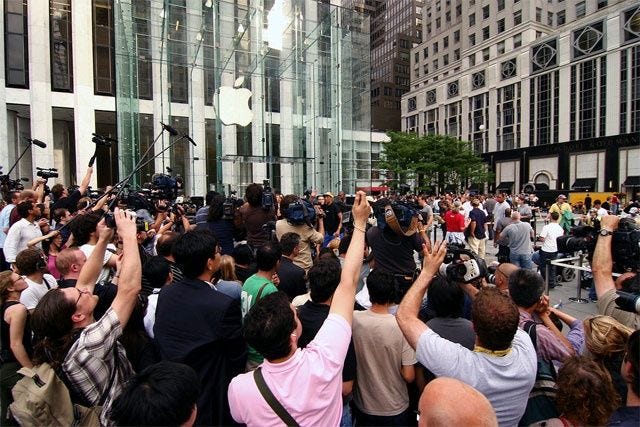
Let’s go back to the first iPhone, launched in mid-2007. I was there, in a line with hundreds of others queued to get my hands on Steve Jobs’ latest marvel.
I have bought every iPhone since, and as it has looked more and more tired, it sparked a question in my mind.
How much have I spent on iPhones?
The answer is just short of US$10,000 over 19 years.
But if I had taken the $500 I spent on that iPhone 1 and spent it on Apple stock back in 2007, my investment would now be worth $33,000.
For one phone, that’s now practically worthless.
That naturally leads to the question: If I had never bought an iPhone, and spent the money on Apple stock instead, how much would I have in the bank today?
The answer will shock you. You’d have $105,000. And that’s a pretty chunk of change…
So has Apple been taking advantage of us? Or are we missing something deeper?
It’s a good question, so let’s find out.
The honest truth is that Apple has been very responsible in its pricing of the iPhone.
Since its very first model, the entry price has only risen from $499 in 2007 to $799 today.
Adjusted for inflation, the price has remained remarkably stable for two decades.
Given how much people view their iPhone as a status symbol, it suggests Apple has been very consumer focused.
But that misses something, and the proof is in that soaring share price.
Because there’s a hidden variable that’s been shooting to the moon…
Apple listed on the stock exchange in 1980 but it went on a boom and bust run for 21 years - until it hit pay dirt with the iPod.
But Apple’s stock really exploded a few years later with the iPhone, which went on to become the most successful consumer electronics product in history.
Those two products had strong profit margins concealed within the price tag.
While the price may not have risen for you as a consumer, Apple was doing some business ju-jitsu out of sight to push up its profits
In 2007, Apple’s profit margin was about 14 per cent, but over time that has doubled.
And we now know that Apple made bank by engineering your phone to keep you in its ecosystem to retain more of every dollar you spent.
Apple didn’t need to raise prices because they were successfully capturing more value from Apple Music, Apple Pay, fees on App Store purchases, Apple TV, iCloud and more.
Apple ensured the barrier to entry remained low and guaranteed a steady cycle of upgrades and sexy new features to keep you locked in - then tolled you.
It’s terribly clever.
And this is why…
I told you earlier that Apple’s profit margin on the original iPhone was 14 per cent, which had doubled over the years.
But the real money comes from the iPhone apps and products Apple tolls you on once it has you hooked.
The money it makes from App Store transactions and recurring monthly subscriptions have margins of 75.4 per cent.
And Apple’s also paid more than $20 billion-a-year by Google to ensure it’s the default search engine on your phone too.
So what does this mean?
In hard terms, the three billion iPhones sold over the years - including every one of mine - were bought by people who got milked.
While the shareholders who bought the company have made bank.
And that’s a good thing to know if you want to get ahead.
Because investing the same $10,000 in iPhones has left me with some expensive paperweights. If I had invested in Apple stock, I’d be sat on a house deposit.
This has been Future Media Explains, thanks for tuning in. I love answering your questions, so please send them in below.
See you next time…


