

I caused a stir on LinkedIn with a post this week, and it led to an important question from a friend of Future Media which needs answering.
My post was explaining why we haven’t had a decision on breaking up Google’s illegal ad tech monopoly.
Basically, the judge Leonie Brinkema has been super busy.
The Google break-up - and with it the fate of the open web - is just one of the many massive cases on her to-do list.
Judge Leonie Brinkema has been busy.
First, she ordered the release of a Venezuelan couple with temporary protected status whom the Trump administration had detained.
And days ago, she blocked Trump’s US$1.776 billion Anti-Weaponisation Fund - a slush fund critics said was rigged to reward political allies, potentially including January 6 rioters.
My post was to share the good news that now she’s free, and unravelling with Google’s illegal antitrust monopoly - and returning the ads that she called the “lifeblood" of the open web - is her top priority.
But back to the question the reader asked, because I had published this chart in the post.
It compared Google own revenue growth (in green) against the falling ad revenue flowing through to the open web, through what Google calls Network ads (in red).
The reader called Myles asked me: “Hey mate, can you explain this diagram to me? Google search I get, but Network?”
It felt like time for another episode of Future Media Explains, so here goes.
Chunky revenue
Google has a monopoly in search, and an illegal monopoly in ad tech.
We know this from the antitrust trials brought by the US Department of Justice over the past few years.
I have covered every day of Google’s antitrust trials over the past three years. They have been the most impactful competition trials in history.
The historic Gilded Age suits that famously broke the railroad, banking, sugar and steel monopolies only ever impacted America and Americans.
Google’s anticompetitive conduct has impacted nearly five billion people, and a break-up has the power to save or break publishing and the open web itself.
You can follow it all in my comprehensive coverage which includes explainers, charts and the real world impacts.
Google is required by law to report its revenue in quarterly updates to America’s Securities and Exchange Commission, the SEC.
And it reports its earnings - which passed a record $402 billion last year - in chunks.
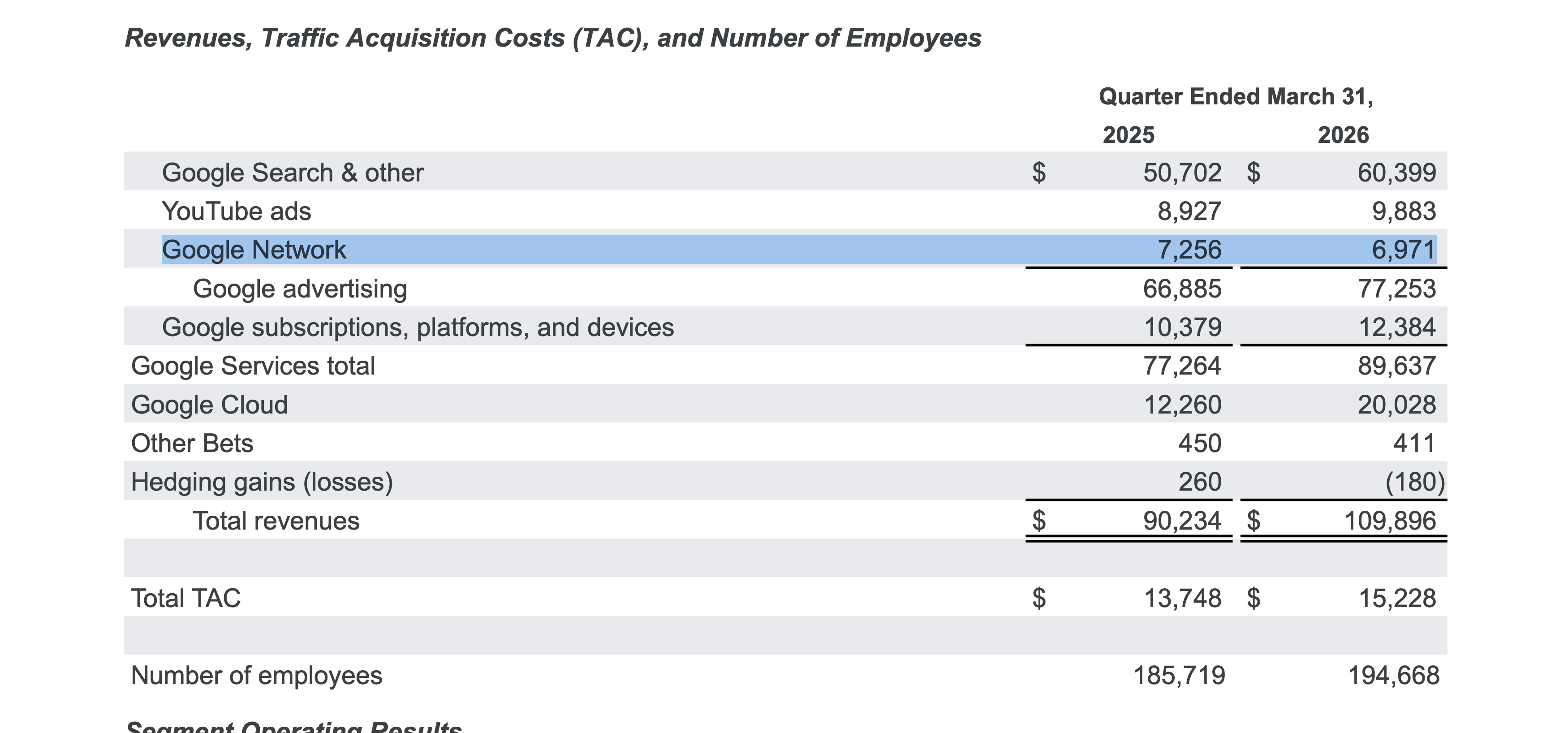
This is a screen from Google’s latest quarterly update showing its revenue (in billions) from Search, YouTube and the Google Network.
And it’s that Network line that I was posting about, and what led to the question.
Network is where Google reports all the other money it makes, and within this number, is how much advertising Google’s ad network shares with the rest of the open web.
Let me explain.
Google has an all encompassing planetary-scale monopoly on digital advertising through its ad tech. It controls how ads are sold, delivered and measured.
It has the world’s most dominant ad server called Google Ad Manager, known as GAM.
Almost all the world’s publishers and almost all ad-funded websites on the web use it to find and deliver ads on their websites.
Google then has an ad network called AdX. Think of it as a dam full of ads looking for a place to be served.
Almost every advertiser and advertising agency in the world relies on it to get their ads from their whiteboards to the people they are looking to sell products to.
And it’s massive.
Around half of all the world’s ad demand - that’s advertisers looking for audiences - is transacted through here.
And we know from evidence surfaced at the trial that its scale is almost impossible to the human mind to comprehend.
AdX handles 252 trillion ad calls a year. That’s 30,000 ads for every person on Earth!
How it works
Let’s say Hyundai wants to sell its SUV to 25 to 35-year-old women who have recently had children and need trunk space who live on the East Coast of the United States.
Hyundai goes to Google’s ad tech, and drops its requirements.
Google’s AdX runs a super-fast auction in a fraction of a second to find websites that have the target customers, and GAM delivers the ad.
Google gets paid at least 35 cents on every dollar for doing that, and the website gets what’s left.
This is programmatic advertising at its most basic, and when it’s working right, then everyone wins.
🖥️ Google gets paid for the tech.
📝 The publisher gets paid for creating the content that attracted the reader.
🎯 Hyundai’s ad reaches the right potential buyer.
🚗 And the consumer gets the car they want.
Only, my chart - the one Myles was asking about - shows how this has been corrupted by the illegal ad tech monopoly that Judge Brinkema is now considering breaking up.
The chart that started it all…
Now let’s explain what it shows.
We have already established that Google controls all the ads looking for customers through AdX, and it controls where they go through the taps and pipes of GAM.
But in 2026, Google wants all the ads for itself, because that’s how it sustains the double digit annual growth Wall Street demands.
Internal emails presented at the trials exposed Google executives “shaking the cushions” to increase prices to meet Wall Street goals.
Google hiked prices and flipped auctions to hit revenue goals

It’s day three of the Google antitrust trial which could reshape the web and force a breakup of the search giant. You can find earlier reports here, but today’s evidence was a deep dive into its search ad business.
But also because it needs cash to fund the colossal investments its making to stay ahead in the AI race.
That has led it to bend the rules, and this chart is the proof ☝️.
To keep as many of the ads for itself, Google launched AI Overviews to replace search.
You might remember that it was Future Media that revealed this back in 2023 when it was a secret Google patent.
The Google patent planning to end publishing - and what to do
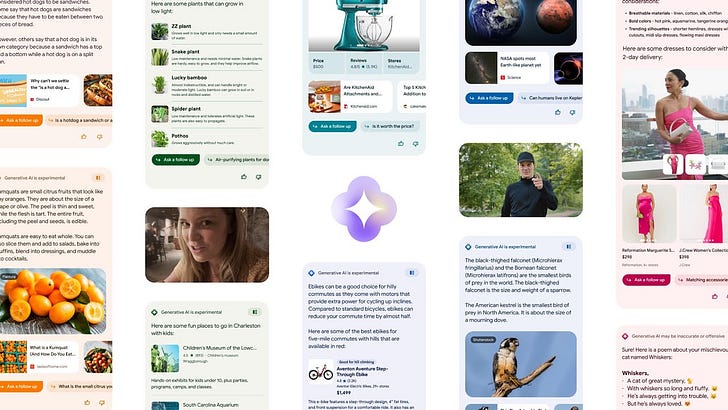
A Google lab has released a 24,000-word patent revealing its plans to pivot from being a search engine into a publisher, and use AI to rewrite the world wide web.
Since then, Google has used AI Overviews to keep readers on its search pages by answering the questions.
Think what that does.
A person goes to search and asks what are the latest headlines in the Wall Street Journal today.
AI Overviews responds with the answers, and the reader does not need to go to the Wall Street Journal.
That means Google keeps the reader, and serves them ads, and does not need to send the reader to the WSJ, so it does not need to share its ad revenue with them.
This isn’t theoretical any more. It’s real. Here it is in action.
Self preferencing
When Google sends readers to a publisher, it’s known in the industry as referral traffic.
Since AI Overviews, referral traffic to publishers has fallen by as much as 80 per cent in the worst cases.
But Google’s not done, because it has also turned the taps and narrowed the pipes to send less of its AdX dam of ads with everyone else on the web too.
And the proof and the impact of both together is what the Network Ads chart I shared shows.
It shows Google keeping readers to itself and monetising them for growth, while simultaneously sharing less of the advertising it controls with the open web.
And the SEC filings show how it’s moving the ads that used to pay for every ad-funded website to platforms it owns, mainly search and YouTube.

The law has a term for this. It’s called self preferencing, and in Google’s court cases this was found to be anticompetitive and illegal.
For the layman though it’s a pincer movement. Google’s sending less readers and less ad revenue to everyone else and suffocating the open web, while using its monopoly to hoard it for itself.
And that is the problem that Judge Brinkema will soon offer her solution for.
Will she force Google to sell GAM and AdX. That’s what the US Department of Justice wants.
Google remedies are in, so what's next for the open web?

The DoJ has outlined how it wants Google broken up to return competition to the digital advertising flow that sustains the world wide web,
Or will she try to change Google’s behaviour so it plays nice and shares like it used to. The DoJ has bleakly called this “putting a BandAid on a severed limb”.
That’s what we are all waiting to hear. It will decide the fate of the $750 billion global digital advertising market
So it’s a great question, and thanks to Myles for sending it. Please keep them coming. There’s plenty to talk about. Stick any questions you have in the comments. 👇
This has been Future Media Explains.
PS: I asked Google’s AI Gemini to fact check this article. It said: “The post is highly accurate regarding the specific news events it references (the Venezuelan couple and the Anti-Weaponisation Fund) and correctly explains the basic mechanics of programmatic ad tech.”


