
Google antitrust enforcer's fired - now it's down to these guys
#443: Meet the trio tasked with deciding what Google must share - and with whom - after the shock firing of the DOJ's antitrust chief...


Welcome to Future Media, and a special free newsletter today as there are major developments in the Google search antitrust case.
But before I jump in, my months-long investigation into Meta’s record on sex crimes published last week went global. Part two’s coming tomorrow.
It’s been shared 99 times, reached tens of thousands around the world, and led to an influx of influential new subs, who I’d like to call out for their work in child safety.
Welcome then to the International Justice Mission in Washington DC which combats human trafficking, slavery, violence against the poor, and other forms of abuse.
It was founded in 1997 by a former DoJ trial attorney who investigated the Rwandan genocide, and operates in 30 countries.
As well as France’s Ministry for Europe and Foreign Affairs, the office of the Prime Minister of Ethiopia in Addis Ababa, The US Department of Homeland Security, the age verification team at Yoti, and an MP and leading voice on the UK’s justice watchdog fighting for an under-16s social media ban.
And welcome also to new subs from The Washington Post, privacy search engine DuckDuckGo, the Yahoo DSP in London, the Hubbard School of Journalism & Mass Communication at the University of Minnesota, the Coalition Against Financial Crime, and fintech Revolut in Dublin, and hundreds more.
Welcome. Please share my work with your network if you find value in it.

Right, now today’s post which is all about the DoJ.
The Big Story: What now as the DOJ’s Big Tech hawk is fired
When Google was ruled an illegal search monopoly, it put the way three billion people worldwide find news and information under a legal spotlight.
The fate of ad-funded digital news was thrown into jeopardy, and the answer relied on how the judge crafted the punishment.
But after playing tough, Judge Amit Mehta then went soft, saying AI was going to bring Google down to size -and he forgot all about publishers fleeced over 20 years.
In his remedy ruling, he ordered Google to share some data with a handful of so-called Qualified Competitors - and then passed that job to a technical committee.
No Chrome sale. No Android spin-off. No publisher protections against AI training. As I wrote at the time: It was a $4 trillion crime without a punishment.
But what about that technical committee? It hasn’t had a lot of attention, but that’s where the action is now - and that’s what I am sharing today.
Those five people have been tasked with deciding who gets Google’s data, what they get and whether the remedy has any teeth at all.
And the first three proposed members have just been named, and I’ve profiled them below. They’re an interesting crew.
But first, the elephant in the room - because what’s just happened is extraordinary.
The Trump administration has now fired its top antitrust enforcer Gail Slater - the head of the DoJ’s antitrust division - days before a critical hearing on the committee's formation.
Most coverage has focused on Slater’s short tenure, her clashes with AG Pam Bondi, and what it means for the Netflix’s planned acquisition of Warner Bros.
But that’s not the timing that really matters, or what the material impact her being shafted will have.
The real story has been unfolding across town at the federal courthouse, where Google, the DOJ and the State of Colorado are fighting over the machinery that will determine how Google’s antitrust remedy goes.
Slater wasn’t a tech sceptic - she was a former exec at Fox Corp and Roku - and her motivation for grinding Google wasn’t consumer protection orthodoxy, it was politics.
She launched herself into The White House’s universe after working as Vice President JD Vance’s economic policy advisor.
President Trump was impressed, praising her for being “tough on Big Tech” and giving her the top job at the DoJ’s pivotal antitrust division.
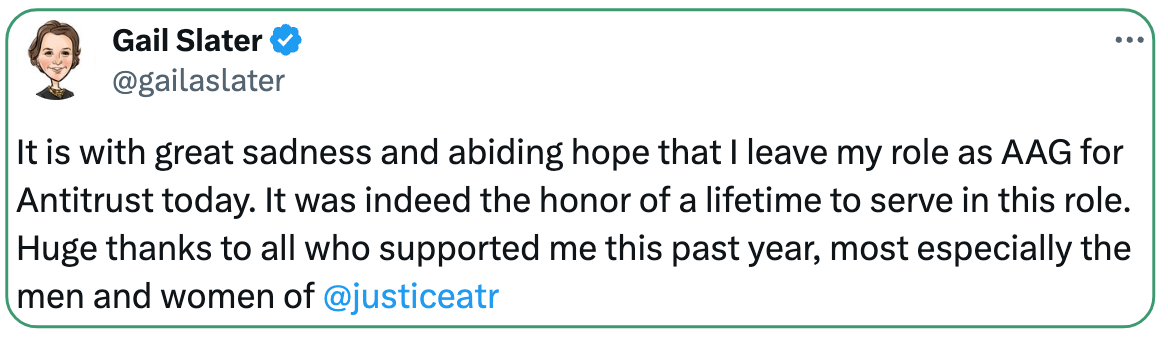
She was his Big Tech hawk - a frontline general in the MAGA culture wars - so it was a surprise when she was forced out on February 12. She posted the news on X:
She was known inside the DoJ for pushing the administration to be aggressive on tech companies - the same leaders who suck up to the President.
Senator Elizabeth Warren told CBS that the ouster “looks like corruption.”
Slater’s departure followed months of rising chaos. Two deputies were fired last year in a dispute over another tech merger, and her deputy Mark Hamer also left this week.
The why is clear. Big business doesn’t want to be regulated - but the timing of her departure is critical for publishers.
The antitrust division senior leadership is being gutted at the exact moment the Google technical committee is trying to get off the ground.
For now, the DoJ is under the control of acting chief Omeed Assefi, a criminal enforcement specialist, not a tech antitrust wonk.
Tick-tock
On Valentine’s Day - February 14 - just 48 hours after Slater was shown the door - DoJ attorneys were back in the courthouse with Google.
They were arguing before Judge Mehta whether the technical committee needed to be full time and paid like Silicon Valley execs.
Google wanted part-time low pay folk. The DoJ wanted big names on big money, arguing the remedy was “way more complicated” than Microsoft’s 24 years earlier.
Judge Mehta gave both sides until tomorrow to agree, and said he would then ratify the names 24 hours after that.
The DoJ nominated the committee’s chair. Colorado - the US State that led the antitrust complaint proposed another.
And Google threw its nominee in for the third seat.
This is who was chosen.
Win or lose
The DoJ's case was filed in October 2020. A bipartisan coalition of 38 states, led by Colorado AG Phil Weiser, filed a related action weeks later.
By the time remedies were ordered, 49 states had joined.
AG Weiser told me in an exclusive interview: “There’s every risk in every antitrust case that you can win a liability and then lose the remedy if it is not implemented.”
It also underlines why the people on this committee matter so much. So let’s meet them.
The DoJ’s pick: Chair Tammy Savage
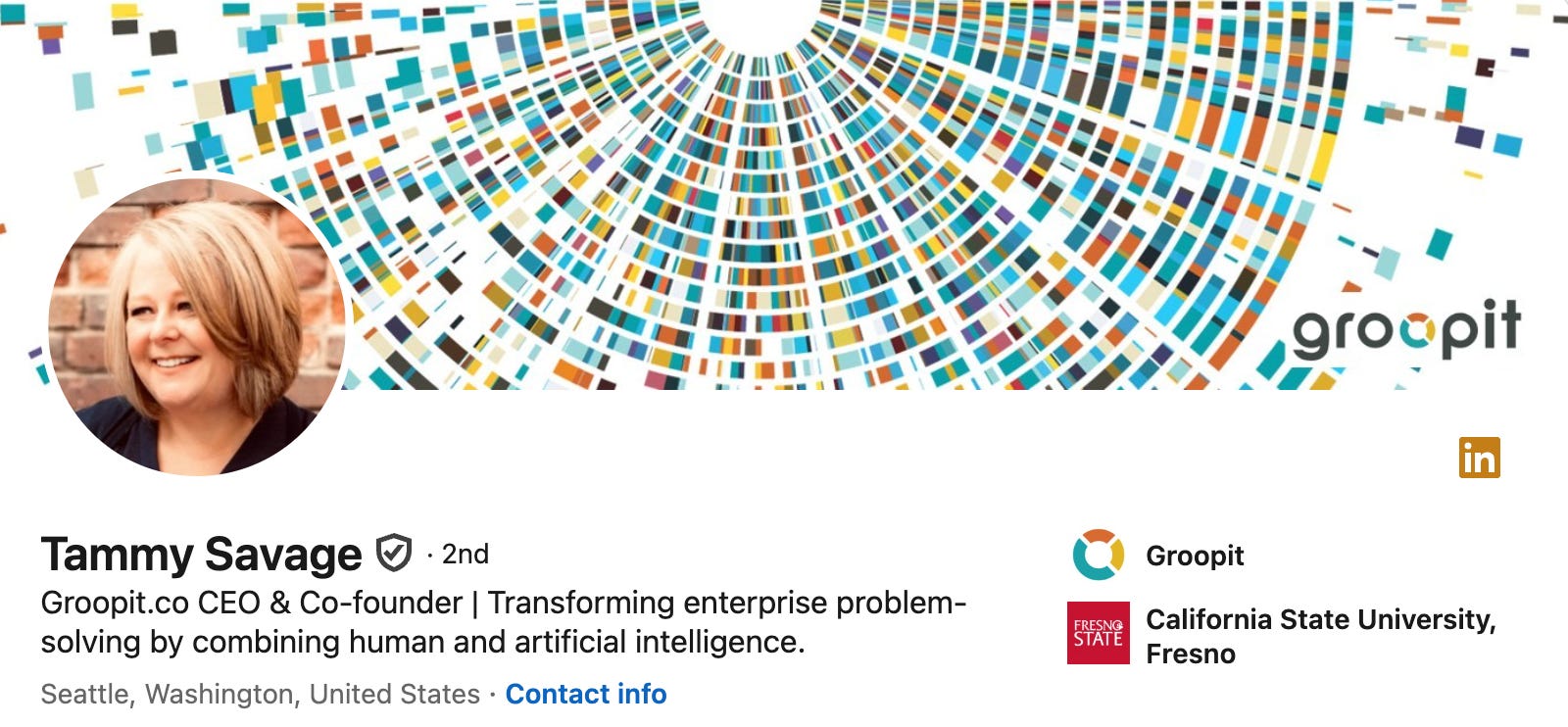
She’s currently CEO and co-founder of Groopit, a Seattle-based AI company, and she has an intriguing backstory.
She spent 22 years at Microsoft in a string of leadership roles, right up to VP so she knows tech’s plumbing, politics, and playbook.
Her Microsoft career was anything but conventional.
She butted heads with Bill
In 2000, aged 30, she recruited 12 college students and put them in a house in Seattle for three weeks Big Brother style to watch how they used tech to communicate.
What she found led her to pitch then chairman Bill Gates and CEO Steve Ballmer that Microsoft was old, fuddy-duddy and out of touch.
She said the reception was “chillier than a campsite on Mount Rainier” but she harangued them until they eventually listened.
Her vision went on to shape Microsoft’s strategy on messaging and Xbox gaming.
She’s a doomsday prepper
A GeekWire profile in 2018 says she analysed “societal disintegration during disasters” and explored ways Microsoft could prevent it with response and recovery.
She studied crime and terrorism prevention, and infectious disease outbreaks - before Covid - and modelled the impact.
Her goal was to find ways to utilise tech to make the world more resilient in the event of systems and people falling apart.
Why’s she the DoJ’s pick?
The DoJ flagged in its filings that she worked extensively on data privacy and security compliance and spent two decades in the belly of a tech monopoly.
Their logic: She knows where the bodies are buried - or more precisely, why the chat logs were deleted. Remember this?
The question after this week though is whether she still wants the gig if she doesn’t know the DoJ still has her back.
Colorado’s pick: Search veteran Gerry Campbell
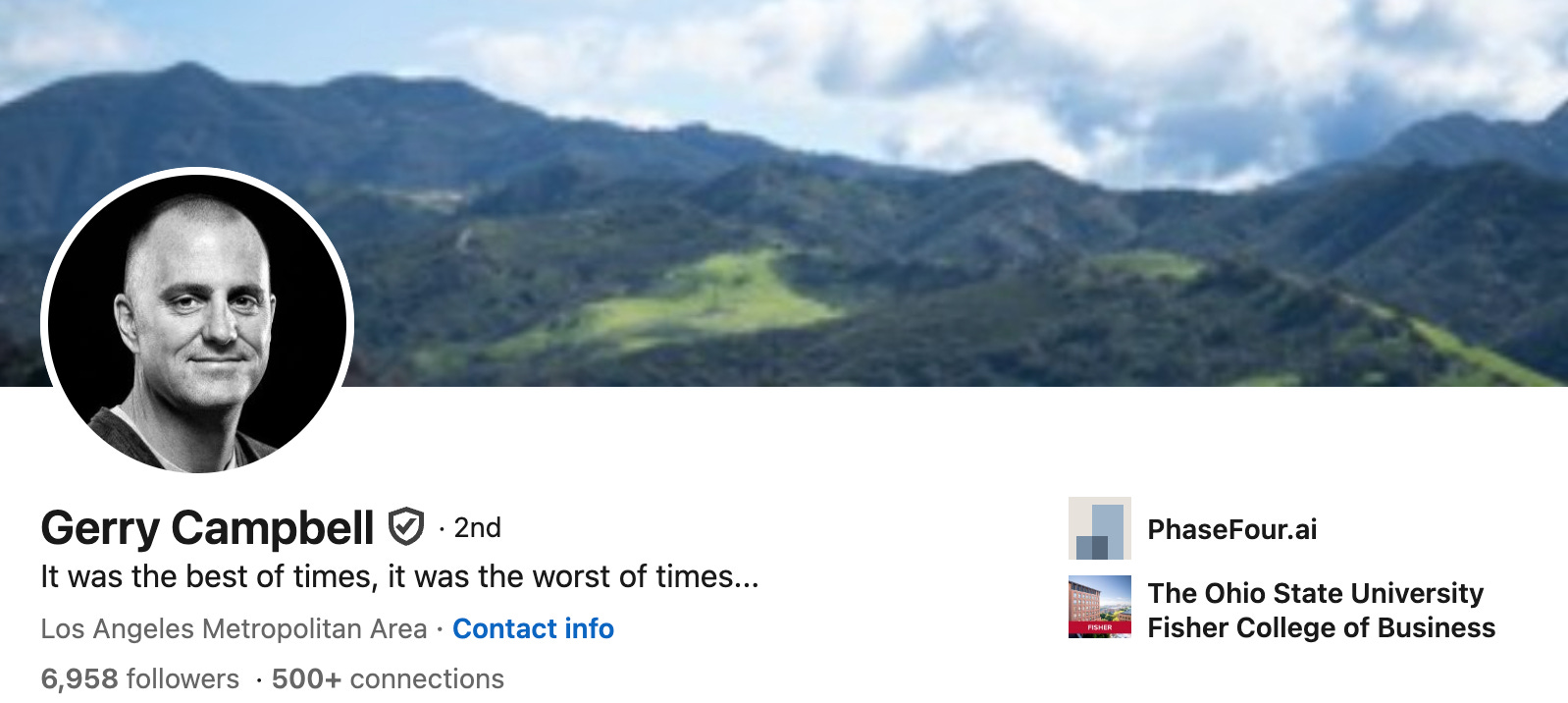
Savage knows how Big Tech operates. Campbell knows how search works. He was literally there when the industry was invented.
He started at CompuServe in 1994, moved to Compaq, then to AltaVista as Director of Strategy during the early search wars.
In 2001, he joined AOL as Senior Vice President of AOL Search, running all of the company’s search businesses.
Here’s the part that should make Google nervous.
At AOL, Campbell drove more than $400 million in annual revenue and launched the first paid search partnership with Google.
He was Google’s business partner before Google was Google.
He also holds the original US patent for search box auto-suggestions - the feature you use every time you type a query.
He’s also worked a stint at Reuters, so he has insights into publishing.
He’s the one who can look at Google’s data-sharing proposals and know instantly whether they’re meaningful or performative.
With the DOJ’s leadership in disarray, Colorado’s man has just become the most important person on the committee - and voice on publishing’s future.
Google’s pick: Privacy expert Prof John Abowd
Google chose John Abowd, the Edmund Ezra Day Professor Emeritus of Economics, Statistics and Data Science at Cornell University.
This is strategically interesting.
From 2016 to 2022, Abowd was chief scientist at the US Census Bureau. While there, he designed and deployed the biggest privacy shield any government has ever built.
So why would Google choose him?
The clue can be found in Google’s defence strategy at trial. Its go-to argument against break-up was that sharing search data would threaten privacy.
Hand over our index to competitors, its lawyers warned, and you risk exposing the secrets of what hundreds of millions of people search for every day.
Abowd has spent a career figuring out how to let people use sensitive data without exposing the individuals behind it.
Google’s gambling the world’s leading authority on data privacy will validate its defence.
You might’ve noticed he didn’t post an image on his LinkedIn profile ☝️
What it means for publishers
Publisher traffic is collapsing as Google pivots from search links to AI generated answers. How publishers’ content is discovered is in flux.
Google’s Chrome browser is the dominant way most people access news websites on the web. That makes it critical to news discovery.
Google’s also the world’s largest ad company and the amount it shares with publishers and the open web has been falling for years. That makes it vital to monetisation.
Google holds the trifecta of discovery, distribution and monetisation for the entire world’s publishing industry.
This technical committee has its hands on the future of two: Discovery and distribution.
Google also lost its antitrust trial against its ad tech monopoly. The remedy on that is due in the next month or so. Another technical committee will be needed for that.
Qualified competitors
Savage, Campbell and Abowd’s first job - assuming they get the chance - will be to decide who qualifies as a Qualified Competitor.
Qualified competitors has just become the most powerful and valuable 20 letters in the world.
That’s because the judge has decreed that only the “qualified competitors” the technical committee chooses will be given Google’s data.
The $13 trillion question then is who will qualify? Will it be publishers? Can it be start ups? And what do they get?
Strap in. Here we go.
The ruling says: “Google will have to make available to Qualified Competitors certain search index and user-interaction data, though not ads data.”
A qualified competitor will be “any provider of, or potential entrant in the provision of a General Search Engine or of Search Text Ads in the United States, or a GenAI Product in the United States.”
The DoJ had wanted a narrow definition focused only on search, but the judge expanded it to AI.
“The use case for a GenAI product like ChatGPT is not limited to search. OpenAI, Anthropic and Perplexity, arguably would not be qualified as presently defined.
“To leave no doubt, the remedies extend to such companies” and also added a requirement that it has “a plan to invest and compete in search and/or search ads”.
That will king-make OpenAI.
On the final day of hearings, ChatGPT product chief Nick Turley told the court that getting Google’s data would enable ChatGPT to build its own search index within five years.
OpenAI has soared in recent years, so a leap via court-ordered data from Google gives America’s AI frontrunner a massive surge in the race with China.
The court also released data that OpenAI had shared on its estimates of who is leading in AI in the US.
In December 2024, it was:
OpenAI: 85 per cent
Anthropic’s Claude: Three per cent
Google Gemini: Seven per cent, and
Perplexity and Copilot making up the remainder.
Oh, and don’t forget this. Google got the data it’s now sharing by illegally monopolising the market but… it’s allowed to charge the qualified competitors for it.
“Such syndication shall occur largely on ordinary commercial terms that are consistent with Google’s current syndication services,” the papers say. 🤦🏼♂️
The DoJ is saying potential competitors have already come knocking, but the court has set the bar high.
Qualified Competitors must be willing to invest billions in search and meet US national security requirements.
The committee will screen those applicants, set the data security standards, and determine what “commercially reasonable terms” means.
One more thing. Google is actively appealing its loss in the search antitrust trial and has asked the court to freeze its obligations to share data while the appeal plays out.
I’ll be reporting how this plays out.
Thanks for reading.
Finally, I’m launching a new feature of the newsletter called Future Media Intelligence (FMI).
With so much data out there it can be hard to extract insights from the noise. That’s the logic behind FMI.
My team and I will gather data we access through our everyday work and synthesise it into graphs, charts and maps.
We will embed these in newsletter posts and organise them in a single database where they can be accessed, ready, reliable and board ready.
I’ll share more in the weeks to come, but here’s a little taste of what’s to come. We did this just this morning.
For hundreds of insights like this, bookmark Future Media Intelligence.
In re: the data-sharing conversation, here's a thing I've never understood about publishers and Google that maybe you can help me tease out:
Publishers don't use or trust the data Google has been giving away for free for years about user interaction, topical interest, and general search performance. Publishers often position themselves as victims here, but in my experience, they never staffed up their digital strategy teams with folks who understand how to read and react to trends and topical data from search. Whereas brand marketers are extremely familiar with search intent, long-tail, and how/why audiences use platforms, publisher teams dismissed Google's data outright or refused to invest in mining and understanding research tools like SEMRush/Ahrefs. (I don't blame anyone here because SEMRush/Ahrefs are both kinda sketch, but the fact is that publishing ignored user data because they erroneously believed they knew their audiences better than Google, as Google built its global user base.)
Publishers also underinvested in tech and content SEO for years, hiring the dudes who are loud online rather than more experienced product-oriented consultants. The term "SEO content" is still thrown around by digital publishers, as if content created for SEO should be different than content created for other audiences. There's no holistic cross-channel thinking; optimization for both search and social is most often channel-specific and limited.
I don't think there's anything publishers will receive from Google via the antitrust that they can't already see in their own GA4, GSC, and keyword research tools. The fact remains that Google is a discovery tool, not a publishing business, and any publisher that understands how to combine data with a great product can still succeed. (Also, any publisher who can build successful context-based ad ops apart from Google and predatory programmatic platforms will do well.)
It's highly likely that publishers won't know what to do with the firehose of data Google will release. The issue is more that publishers continue to adopt the victim stance instead of understanding the business realities of the audiences and technology they're working with.