
A tech billionaire, a closed beach and a dog who can't read signs
#458: What a small, brown act of civil disobedience tells us about how tech's power and a growing wealth imbalance is hurting the things we love...

A month ago, a Silicon Valley insider reached out to me after 30 years inside California’s magic-money-making-bubble. He wanted to share.
That newsletter - Don’t Be Evil was always too low a bar - has become one of my most talked about guest posts.
He wrote about his 8,000-mile drive across America with his dog Paco meeting people and putting faces to the damage the addictive tech he helped create is causing.
Now Arthur Morgan (IRL) is back after he and Paco had an unexpected encounter with a tech billionaire on a deserted beach...
Welcome to new subs over the past few days from the newsdesk at Bloomberg in New York, the data intel team at the UK’s Independent in London, broadcaster NPR in Washington, the Princeton School of Public and International Affairs in New Jersey, the CEO of Belgium’s news agency Belga, the tech, media and telco leadership team at Deloitte, internet infrastructure giant Cloudflare in San Francisco, information wellness platform Readocracy in Toronto, publisher growth and subscriber platform BlueLena in the US and premium ad formats firm Adnami in Copenhagen, among many others…
And thanks to Maurice Blackburn, the law firm leading Australia’s publisher class action against Google for allowing me to share a stage with Australia’s Attorney General and several judges at their conference this week. 🙌
If you were there you will hear echoes of what I said in Arthur’s words that follow.
He reminds us that beyond AIs mega-trillions, billionaire megalomaniacs and IPOs this week to fund megacities on Mars, tech really only exists to serve people.
A few just seem to have forgotten.
This a free post but my work costs time and money and I have bills to pay, so please consider becoming a paid sub so I can continue to share insights like this.
Over to you Arthur…
A few weeks ago my dog Paco and I went for a hike with a friend I’ll call Todd. Todd sold his company late last year and was doing what newly-liquid Silicon Valley people do once the dust settles.
He was trying to figure out what comes next.
We met at Windy Hill Open Space Preserve, a 1,000-acre ridge above Portola Valley, the kind of town that exists in a perpetual state of mild embarrassment about its own wealth.
Horse stables. Single-lane roads with no sidewalks, because sidewalks would be too suburban.
It’s exactly what TV writers reach for when they want to caricature Silicon Valley’s down-to-earth pretensions.
The trail starts in the trees, then climbs into open grassland. About a quarter mile up, a cottontail darted across the path.
Paco - a Spanish Water Dog who has never knowingly let a rabbit go unchased - stood at attention but, to his credit, did not pull.
A few minutes later, a pair of quail scuttled into the brush. From somewhere above, the sentry quail called Chi-caa-goooo, announcing our presence to the entire mountainside.
Todd is one of those people you don’t need to fill silence with. He listens. He remembers. He observes.
We talked about how rare it’s become to stand somewhere with no notifications, no screens, no glow. Out here, nothing pings. You have to actually look at things.
About a half mile in, an older man came down the trail toward us, walking a large black Labrador.
I shortened Paco’s leash and moved to the left side of the trail. Paco, for once, did not growl. We nodded at the man as he passed. He nodded back, I think.
Todd waited until the man was out of earshot. He leaned over and said, in the slightly conspiratorial tone reserved in these parts for celebrity sightings: “That was Vinod Khosla.”
He paused for effect. “Co-founder of Sun Microsystems.”
I had, in fact, heard of Vinod Khosla. Most people who pay attention to Silicon Valley have.
After co-founding Sun, he spent nearly two decades as a partner at the VC firm Kleiner Perkins, making the kind of bets - Juniper Networks, Cerent - that other VCs still tell their grandchildren about.
In 2004 he launched his own fund, Khosla Ventures, with a particular taste for clean tech and long-odds moonshots.
But that wasn’t where I knew his name from.
It was from a stretch of coastline about 20 miles southwest of where we were standing. A small, scalloped cove called Martin’s Beach, which Khosla had bought in 2008 for around US$32 million.
And then, for reasons that have been litigated in California courts for the better part of two decades, decided the public should no longer be allowed to visit.
A bit of background, if you haven’t followed it.
For roughly a century before Khosla bought the property, the previous owners let people drive down to the beach for a small parking fee.
Families came for the summer. Surfers came for the swell. Fishermen came for the rockfish.
Keep in mind that under California’s Coastal Act, every beach in the state below the mean high tide line belongs to the public.
What Khosla bought in 2008 was not the beach. He bought the only road that gets you to it.
After the sale, the gate got locked. The Surfrider Foundation sued. The California Coastal Commission got involved.
A state appellate court ruled, in 2017, that he needed a coastal development permit to close public access.
Khosla appealed. He appealed again. He appealed all the way to the United States Supreme Court, which in 2018 declined to hear the case.
The beach is, depending on the day and the mood of the people Khosla pays to keep the rest of us out, either accessible or not.
I’d been meaning, I told Todd as we walked, to drive down and see the place for myself.
He nodded.
We kept climbing.
An uphill climb
As we worked our way up the hill I asked Todd about Sam Altman, whom he’d known a little from a stint in Y Combinator, the startup accelerator Altman ran before OpenAI.
“Is he as two-faced as the New Yorker piece made him out to be?”
Todd thought about it. “He’s a brilliant guy. Super smart. Genuinely curious. But on the duplicitousness thing? I think that’s probably fair.”
We talked, the way two people of a certain age talk when they’re trying to understand what’s happening to the country and the world, and about whether any of this could be fixed.
A per-token tax on AI companies to fund a universal basic income? The companies are still losing money, Todd pointed out. Antitrust? Slow. Regulation? Slower.
We agreed that the people most able to do something tend to be the people least incentivised to do anything.
We ran through the short list of billionaires who seem to be using their money well.
MacKenzie Scott - Jeff Bezos’ ex-wife - quietly giving away tens of billions, no foundation bureaucracy, no naming rights, just cheques landing in the bank accounts of organisations that need them.
We couldn’t think of many others.
At the top of Windy Hill the wind picked up. Paco, who hadn’t appeared to break a sweat, retrieved a bumper as Todd and I caught our breath.
Todd took a selfie of the three of us. The view stretched from the bay to the ocean in a single sweep - the kind of view that costs, in this zip code, about US$20 million to wake up to.
Up here, it was free.
Free because, 45 years ago, this ridge was supposed to be a subdivision and then a nonprofit - the Peninsula Open Space Trust - raised the money to buy the land and handed it to the people.
The view became public instead of private. The reverse, in other words, of what would later happen at Martin’s Beach.
On the way down the trail levelled out across a south-facing meadow where three black-tailed does were grazing - ears cocked, entirely unbothered by us. We paused to watch them.
I couldn’t shake the small irony of running into Vinod Khosla on a public trail.
A week later, on a cloudy Tuesday afternoon, Paco and I loaded into my truck and headed for Martin’s Beach.
Permission slip
The turnoff from Highway 1 is easy to miss. There’s no sign - or rather, the sign that used to be there, the one that said Martin’s Beach in friendly blue paint, has been gone for years.
My GPS told me to turn. I turned.
The famous gate was open. To the left of it, a sign: RIGHT TO PASS. By permission, and subject to control of owner.
Below that, a bigger sign: NO DOGS ALLOWED.
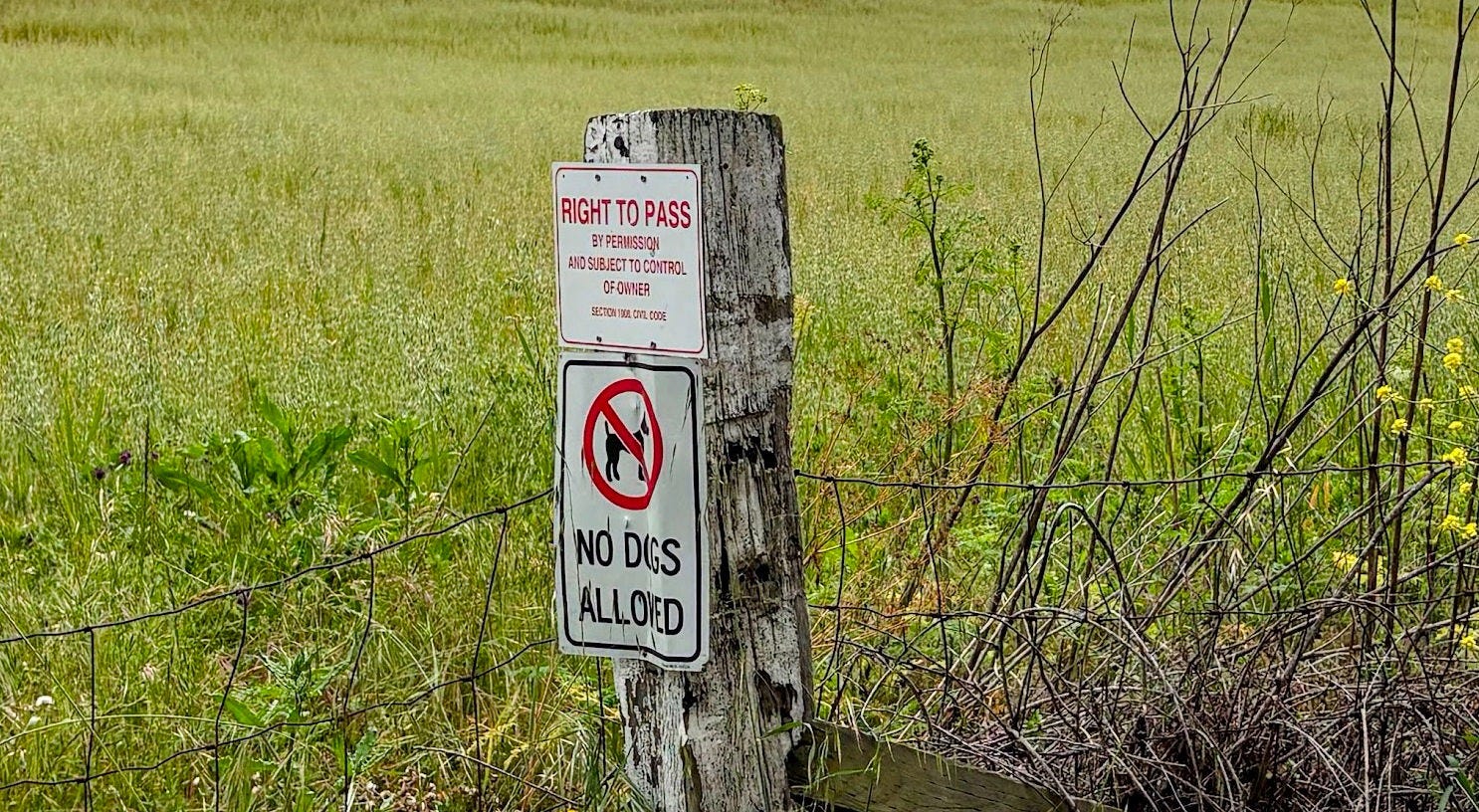
I had to laugh at the no dogs sign.
Khosla, as anyone who’s read a profile of him knows, is a dog person. He’s tweeted about his love of dogs. He’s spoken in interviews about his dogs. I’ve seen him walking his dog in a public park.
There is, I suspect, no version of the world in which Vinod Khosla would walk down this road and obey his own sign.
Paco, who cannot read, sat up in the back seat and looked out the window as we drove the mile down to the beach.
The toll collector
The parking lot was a small gravel patch across from a row of rusting mailboxes. A hand-painted board read $10 parking, 9am–5pm.
One car was there - an old station wagon - and beside it stood a tall, grey-haired man in a windbreaker.
“Is somebody collecting parking today?” I asked.
“That’d be me.” He looked over my truck - paddle board in the back - then at Paco in the cab. “You can go out if you want, but the surf’s not great today.”
“I don’t need to surf here today. Just wanted to see the place.”
“Suit yourself. Pull over there. I’ll tell you a little history.”
I handed him a ten. He wrote my name and license plate in a paper logbook, and handed me a stub.
“I’m John,” he said.
John grew up coming to this beach in the 1970s and ‘80s. People would park down on the sand. Whole families. Surfers, fishermen, kids running barefoot from sunrise to sundown.
“It was like a Beach Boys movie,” he said. “All weekend, every weekend, the whole summer.”
Faded glory
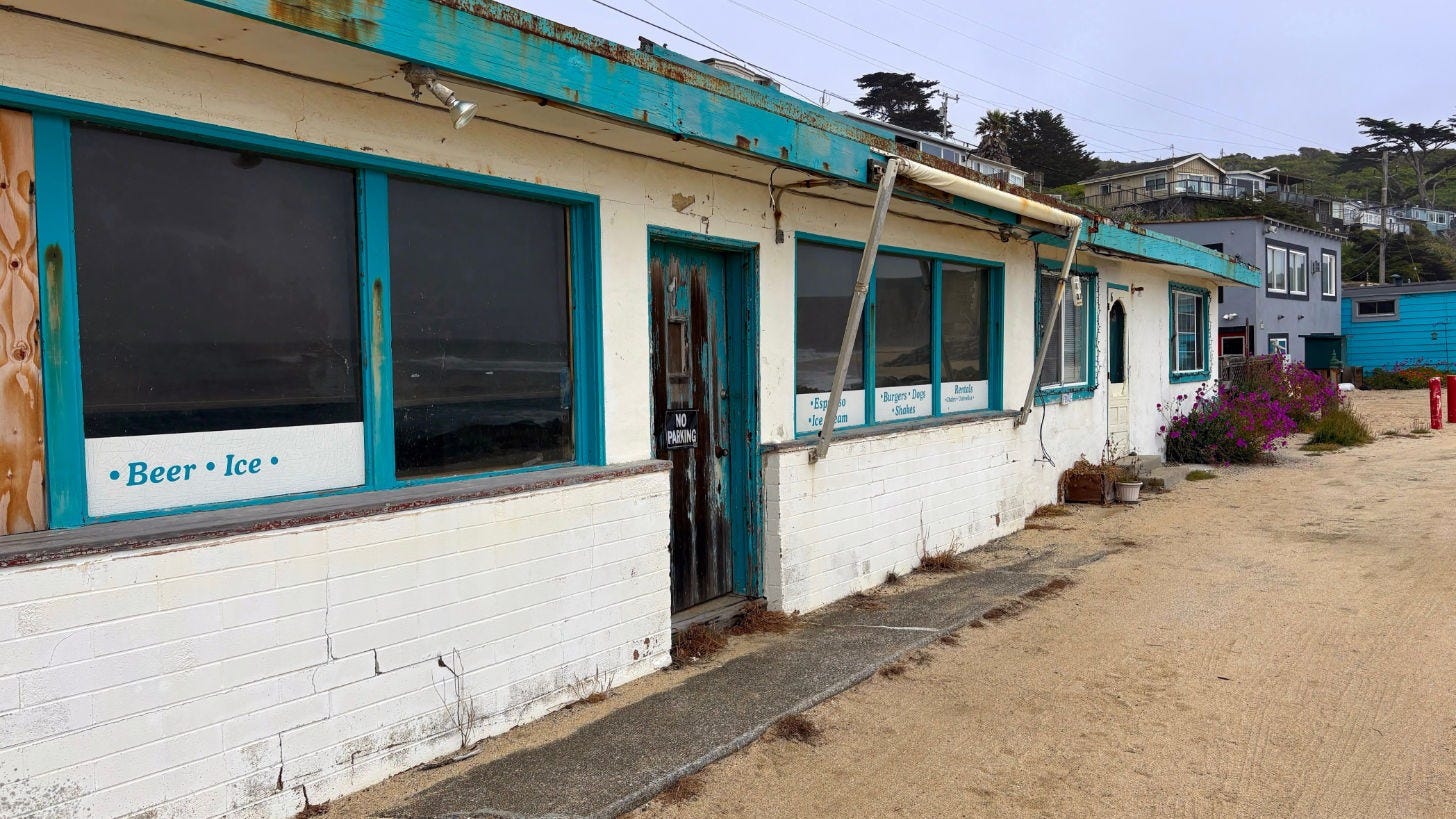
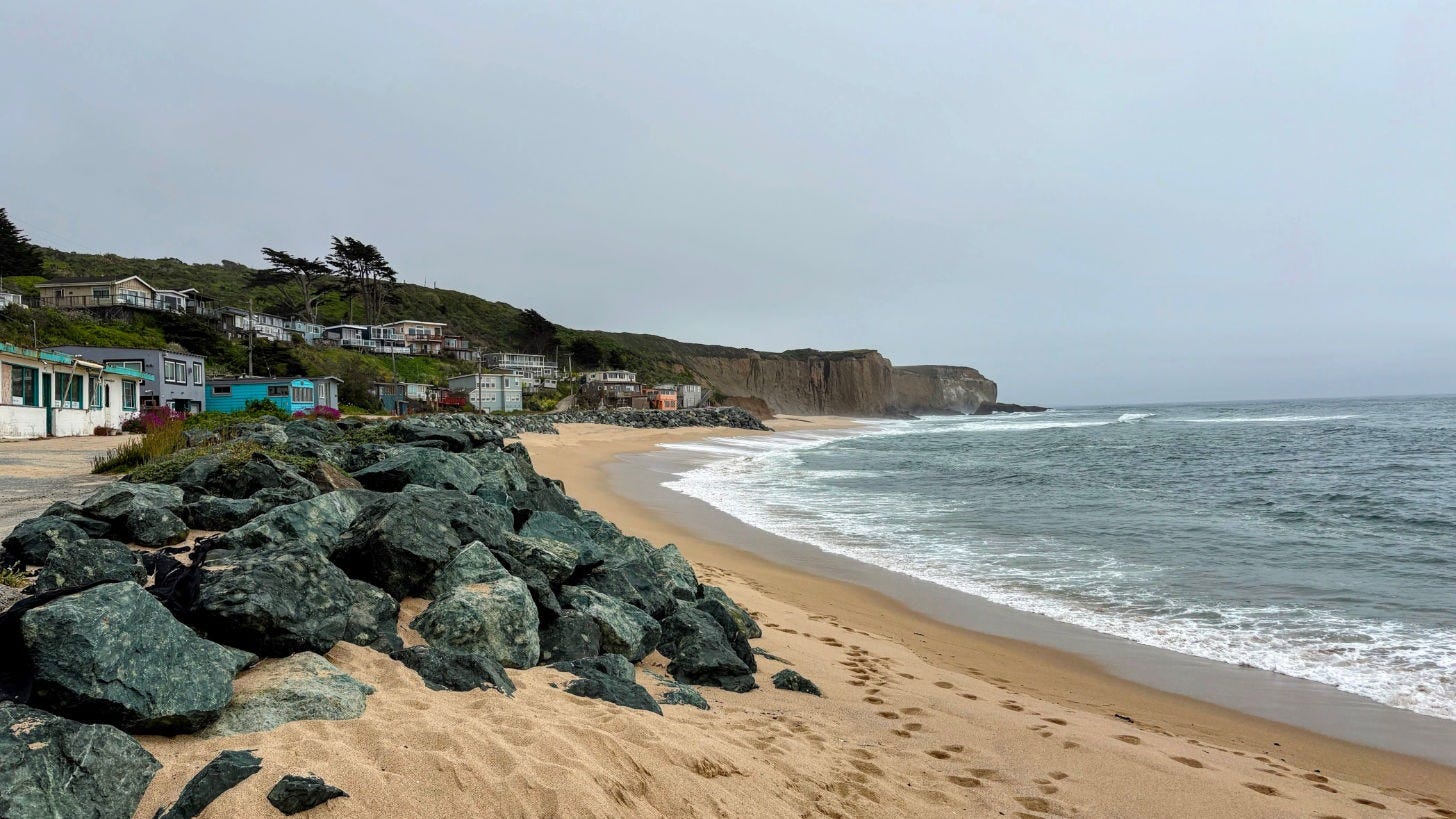
Paco and I walked down to the beach. Past the parking lot was a row of one- and two-storey cottages that had once been rental cabins, I think.
The paint was peeling. The windows were cloudy with salt. Behind the shacks, a couple of beat-up cars. A clothesline strung between them, laundry moving in the wind.
Someone still lived here, paying rent to the new landlord.
A faded mural on the retaining wall along the access road showed what the place used to be: A fisherman holding up his catch, a mother with her jeans rolled to the knees, a grandfather guiding the hands of a small boy as a wave rolled in.
The paint had been bleached by 18 years of salt and wind and deferred maintenance. Every gust of salty air took a little more of it away. No one was coming to repaint it.
The crumbling cottages and the fading mural are part of what makes the place feel haunted.
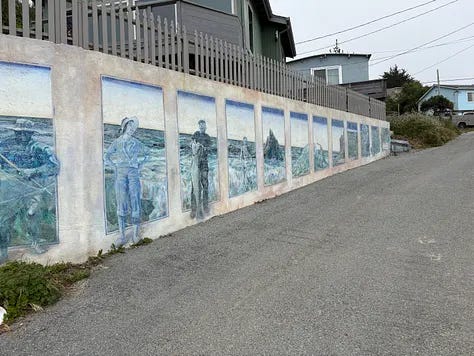
This used to be a working stretch of coast. Not a resort. Not a destination. A place where, for about 100 years, you could pull off the highway and put your feet in the Pacific and buy a Coke from a surf shop dude named Frankie.
Now it’s a US$32 million piece of evidence in an ongoing argument about what still belongs to all of us, and what’s for sale to the highest bidder.
Right of refusal
Paco and I walked north, toward the sea stack at the end of the cove - a single jagged rock that, from the right angle, looks exactly like the dorsal fin of a great white shark.
The waves were bigger up there, breaking hard on the sand. The wind had picked up. There was, as John had warned, nobody else in sight.
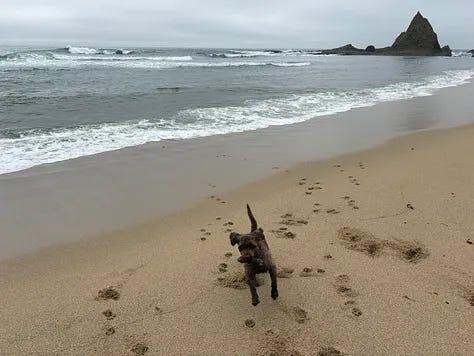
Paco trotted ahead, nose down, doing the thing he does where he zigzags across the wet sand looking for treasures.
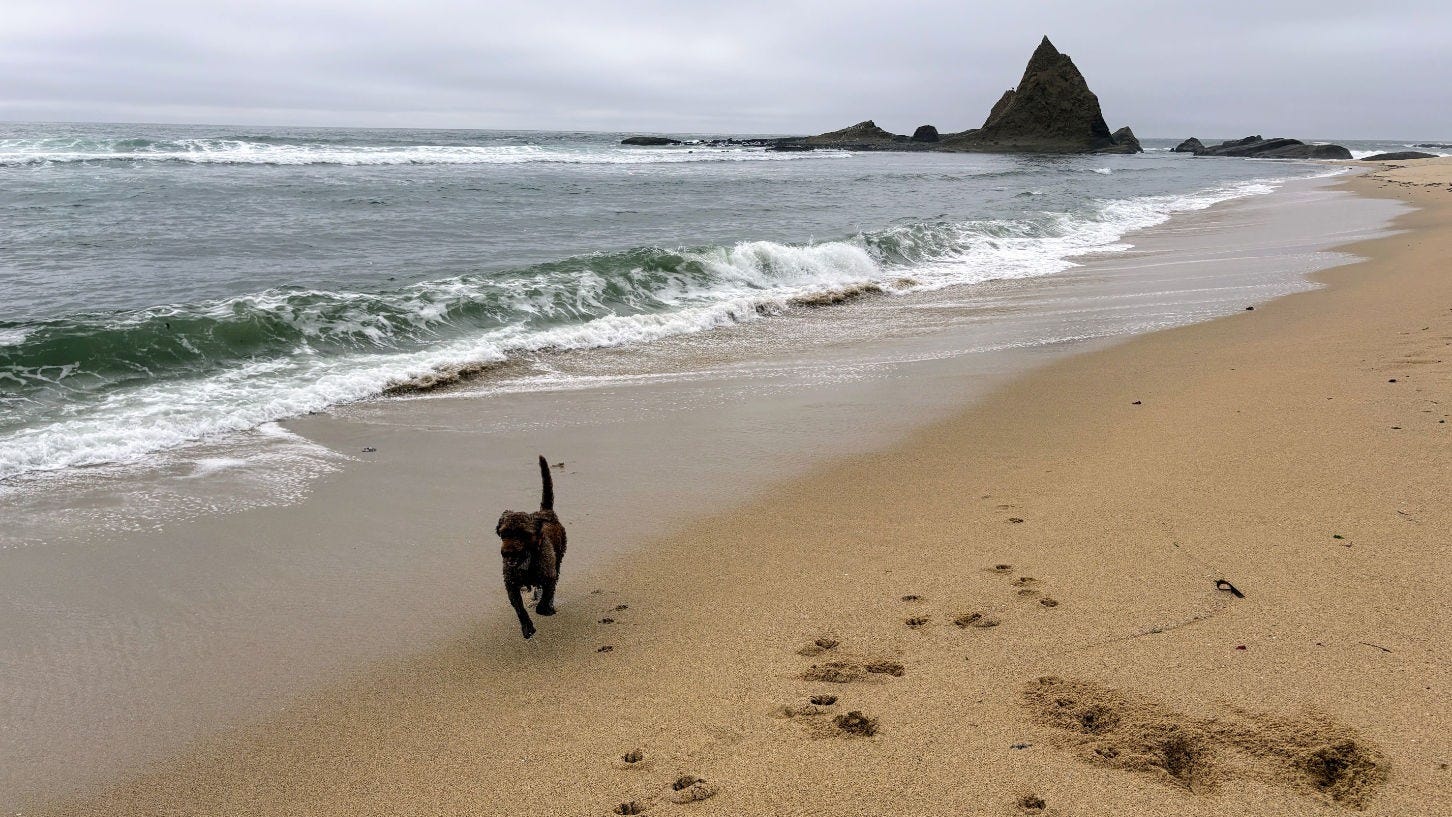
He found one - a piece of driftwood about the size of his head. He brought it back, dropped it at my feet, and barked once.
The bark of a Spanish Water Dog at the water’s edge is not really a request. It’s a directive.
I looked around. The sign at the parking lot had said NO DOGS ALLOWED. The other sign, the one at the gate, had said RIGHT TO PASS: By permission, and subject to control of the owner.
I unclipped his leash.
I threw the stick. He charged the surf, grabbed it, and came galloping back, ears flapping, tail in full propeller mode. I threw it again. He ran again.
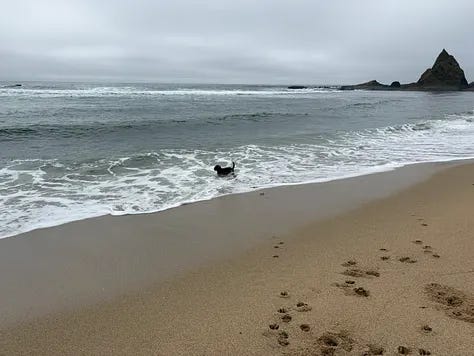
We did this 20, maybe 30 times, until my arm was sore and his tongue was hanging sideways out of his mouth and the wind had blown so much sand into my eyes that I could no longer tell where the grey of the sky met the grey of the water.
It was a small thing. One stick. One dog. No witnesses. Vinod Khosla will never know. His lawyers will never know. The tide will scrub the sand clean by morning.
The stick is still out there somewhere, half-buried, ready to be found by the next dog whose owner chooses, for whatever reason, not to read the sign.
But I will know. And Paco will know.
And - though they are no longer here to throw sticks - John’s parents will know, and the kid in the mural who’s holding his grandfather’s hand will know, and the fisherman with his catch will know.
This stretch of sand belonged, for 100 years, to anyone who showed up. It still does, I think.
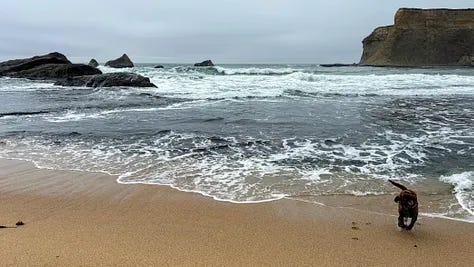
The law is on Khosla’s side in some ways and against him in others, and the lawyers will sort it out eventually, the way the lawyers sort out everything - slowly, expensively and in a way that mostly benefits the lawyers.
But the beach itself doesn’t care about the lawyers.
The beach belongs to whoever is willing to drive down the unmarked road, pay John his $10, walk past the mural, and let their dog off the leash.
The inheritance
The drive home was quiet. I thought about the quail at Windy Hill. I thought about Khosla’s black lab. I thought about the people in the cottages who, presumably, were still in there when I left, watching the same water their grandparents watched.
I thought, also, about Todd - my new friend, the one with the freshly liquid bank account.
Todd is, by his own admission, still figuring out what to do with what he has. He’s been meeting with people. He’s been reading. He’s advising other recently-cashed-out founders on how to use their money in ways that actually do something positive.
He is, in his quiet way, trying to be a different kind of wealthy person than the one we passed on the trail.
I don’t know whether Todd will succeed at making the world a better place. I don’t know whether MacKenzie Scott’s example is the start of something, or just an outlier.
But I do know that those of us in this generation - who built the internet and the iPhone and the platforms - get to decide how we are remembered.
Will we be known as the generation that locked the second Gilded Age into place?
Or as the generation that, somewhere in the second half of the 2020s, looked up from the dashboard and said: Enough.
I don’t have a good answer yet. But I am encouraged, at least, that Paco does.
He just wants me to throw the stick.
PS: If you’ve made it this far and you happen to know Vinod Khosla, please tell him Paco says hi.
Arthur Morgan is a former technology executive writing a memoir about technology, community, and what we owe each other. You can reach him on LinkedIn or on his Substack. All photos by Arthur Morgan.
The problem is, those who seek wealth unmitigated have personalities and character that a) don’t really understand other people‘s feelings or maybe care and b) have already shown a gobsmacking lack of community or charitable intentions. We got what we got. Y’all will be remembered for this.
A footnote from me, since this story has kept me thinking since I sent it to Ricky.
I was surprised at how good I felt after Paco and I refused to obey a billionaire's rules. The psychologist Martin Seligman — the man who, decades ago, gave us the phrase "learned helplessness" — later wrote a book called The Hope Circuit. Its argument, roughly, is that the original theory had it backwards. Helplessness isn't learned; it's the default. What gets learned, when we're fortunate, is the opposite: the discovery that what we do can matter. Hope is the part that has to be wired in.
That, in the end, is what the stick on the beach was about. Letting Paco off the leash changed not one fact of the litigation. Khosla still owns the road. But it was a small exercise of agency in a place built to make you feel you have none. And I've come to think that's how the circuit gets wired. You don't reason your way out of helplessness. You act your way out, one unremarkable act at a time.
I'd like to know what readers think: where do you still feel a sense of agency these days — and where has it quietly slipped away?